Friday, May 9, 2008

We are the Weather Makers

.


Chapter 17: Danger Ahead


 Flannery opens this chapter by discussing what is known as "the commitment". This term is used to describe the fact that greenhouse gas emissions being released today will not be felt to their full extent until the year 2050. This term is used to show that what we release today must be an effective and efficient amount of CO2, because if it is not then we are committed to the effects of these harmful amounts in the future. Flannery goes on to say that most of the damage done to our environment occurred during the 1950s in the baby-boom era.

Flannery continues in the following paragraphs and explains examples of things that were used in the 1950s that were particularly inefficient. Products such as automobiles and electric vacuum cleaners made in the 1950s had and are still having immense repercussions on our environment.

According to Flannery there are four major factors relating to the climate change we can no longer prevent. These factors include the CO2 we have already released, the positive feedback loops that amplify climate change, global dimming and the speed at which human economies can decarbonize themselves.

Flannery continues to say that a leading scientist states that a reduction in carbon dioxide emissions of 70% (from 1990 levels) is required, to stabilize our Earth's climate. By doing this, the result would be an atmosphere with 450 parts per million CO2. An increase from what we currently have with an atmosphere with 380 parts per million. This would result in our Earth's climate stabilizing around the year 2100. Stabilizing at a temperature at least 1.1° Celsius higher to as much as 5 ° Celsius higher.

Though this goal seems achievable, Flannery believes a realistic scenario would be an environment with an atmosphere of 550 parts per million of atmospheric CO2. By doing this we would in effect double the pre-industrial levels of CO2 emitted and would therefore increase global temperature by 3° Celsius this century.

Flannery ends this chapter by telling us that our global temperature average is around 15° Celsius. If we allow this to rise by a single degree or 3° Celsius we will decide the fate of hundreds of thousands of species, and billions of people.


Questions for Tim Flannery:

 1. Do you believe we will reach your projected target of 3° Celsius?

2. Do you believe that our world is truly motivated to make the necessary changes that are needed to reduce CO2 emissions?

3. Do you agree with the increased usage of hybrid vehicles such as the Toyota Prius?

Tuesday, April 22, 2008

Gratitude Blog – Letter to Joseph Kertes

.

Gratitude

Book By: Joseph Kertes

Blog By: Corey Trinetti


Dear Mr. Kertes,


Over the past few weeks, I have been engrossed in your novel Gratitude. As you may already know, this book was given to grades 8-12 in my school to carry on with this year’s theme of gratitude. Although I don’t usually read this type of genre, I was willing to give this book a chance as the first book I have read about the Holocaust.


Right from the beginning of the novel I was captivated by your writing. A very easy and effective style of writing allowed a rather inexperienced reader like me to jump right in with no problems. To add to this, the plot of the opening of the novel really caught my attention. Set in Hungary, the book opens with Lili crouching behind a wardrobe wearing a wedding dress her mother had given her earlier that day. While hiding, her cake is burning in the oven downstairs. What appeals to me about this is how well you can depict the tension of the moment. As well, your use of descriptions and imagery of the cake burning add much more realism to the moment.


What I also enjoyed about this book was your use of many characters. At first it was difficult to decipher exactly who was who and what their role in the novel was. Yet as the novel progressed, your lengthy character descriptions painted a colorful picture of each individual character in the novel. This allowed me to associate a lot better with your characters, both with their personality and due to the fact that some of them (i.e., Lili) were relatively the same age as me. Your lengthy character portrayals and scene descriptions also gave me a greater sense of realism to your writing. It didn’t seem like the characters in your novel were made up from little research, your hands-on research really showed through in your writing.


One element to your novel that I really did not enjoy was the sadness and despair it brought to my mind. This criticism has nothing to do with the quality of your writing; I simply enjoy reading a novel with a lighter storyline and not something as heavy as the Holocaust. All in all, I enjoyed reading your novel, because it was a change in pace and it gave me a perspective about the Holocaust which I had never heard of before. I would definitely recommend your novel to someone looking for a captivating story that will make you think!


Sincerely,


Corey Trinetti

Tuesday, February 19, 2008

Blog #7 - Regeneration by Pat Barker

.
Regeneration

Book By: Pat Barker

Blog By: Corey Trinetti

Comment on what worked well in the novel. Provide direct support.

The novel Regeneration by Pat Barker had many aspects that were appealing. For example, its use of themes and, in particular, the theme of madness, worked quite well in the novel. The theme of madness was a recurring theme in the novel Regeneration. An example of this in the novel is that madness was the problem affecting the ‘patients’, i.e., Sassoon and Prior. It was the duty of the psychiatrists at Craiglockhart War Hospital to try and correct the madness that was affecting their patients.


Rivers, a psychiatrist at the hospital, encouraged his patients to try and express their memories and feelings through verbal communication with him. His methods seemed to ‘cure the madness’ because both Prior and Sassoon were eventually released from Craiglockhart; the former going home, and the latter returning to the war.


The use of symbolism in Regeneration also worked quite well, giving the author’s writing more depth and meaning. Trenches are used as symbols, representing graves. Although many patients seemed to have horrible memories of trenches, Prior’s memories of the trenches seemed to stand out. Prior remembered waking up in a trench, and finding two of his men dead as a result of an exploded shell. Prior mixed their remains with lyme in order to use their bodies as reinforcement for the walls of the trench. In effect, the trench was their grave.


Comment on what disappointed you and explain why you were disappointed. Provide specific examples to support your opinion.


Although the novel was quite interesting and meaningful, it did have some elements to it that were somewhat disappointing. One of these elements was the complexity of the writing that the author used. Since the author is from England, and since the book is from more of an English perspective, it often caused some issues in clarity for me. To add to this, the book used many references to the war and society that I was unfamiliar with, having never lived in the time period the book was set in.


The portrayal of more minor characters in the novel, such as Anderson and Burns, also disappointed me. I would like to have read more about these characters and their time at Craiglockhart. Although the novel did tell some stories of these men, I believe that the author could have gone into more detail about them, explaining how the theme of regeneration tied into their lives, as well. While these men did play a significant role in the novel, it would have been less disappointing if they had played an even larger role.


Copy 2 short passages of especially good descriptive writing and explain why each appealed to you.


“‘So, you agree with his views but not his actions? Isn't that rather an artificial distinction?'

'No, I don't think it is. The way I see it, when you put the uniform on, in effect you sign a contract. And you don't back out of a contract merely because you've changed your mind.' “


This conversation between Rivers and Graves appealed to me because of its cleverness. This passage occurs in Part One of the novel, when Rivers questions Graves about his views of the war and about Sassoon’s protest. This quotation appeals to me because, although Graves does not disagree with Sassoon’s views, he must give an answer that follows that traditional English way of thinking. This was a way of thinking that was taught in the English school system of that era.


The passage also appeals to me because Graves is able to answer Rivers’ difficult question while using a good analogy to help back it up. Graves’ quick thinking and sharp intellect allow him to formulate this response without hesitation.


“A horse's bit. Not an electrode, not a teaspoon. A bit. An instrument of control. Obviously he and Yealland were both in the business of controlling people. Each of them fitted young men back into the role of warrior, a role they had—however unconsciously—rejected. He found himself wondering once or twice recently what possible meaning the restoration of mental health could have in relation to his work.”


The passage above describes the thoughts of Rivers after witnessing Yealland's treatment of his patients with electro-shock therapy. The passage is appealing because it is very graphic; it describes Rivers realizing that his nightmare was him trying to shove a horse's bit into the mouth of his patient, Sassoon, who was resisting this treatment.


The author’s use of short and incomplete sentences also appeals to me in this passage because it helps to mimic how Rivers is thinking. Rivers is in almost a panicked state of mind and the short sentences help to depict how is brain is working and how he keeps jumping from idea to idea. These concise sentences also tend to draw the reader’s attention away from the entire passage and move it more toward thinking about the smaller passages, such as the one about the ‘bit’.

Monday, January 7, 2008

Corey Trinetti - The Firm - Fan Letter - Blog #6

The Firm

Book By: John Grisham

Blog By: Corey Trinetti


Dear Mr. Grisham,

I recently finished reading your novel, “The Firm”, and was very impressed on many accounts. I was born in the year when the novel was published, and it was intriguing for me to experience what life was like just 16 years ago. Particularly, I liked the descriptiveness of the settings, from the style of houses, to the color of the Mercedes and to the way people dressed.

What I also enjoyed about the novel was how there was an initial character development before the plot started to formulate. For me, it was good to get to know each of the characters and get inside their head before the Firm was discovered to be corrupt, or before the FBI presented Mitch with an ultimatum. The way Mitch was described as coming from a poor family, and how he wanted to break his poor-middle class ties, gave me great insight into his personality. Likewise, it was good to get to know Abby, the woman he recently married, whom he fell in love with at university.

A theme in the novel that I spotted immediately, and quite enjoyed, was the theme of loyalty. The Firm always made it clear that employees would remain loyal to the Firm, and would never leave, and I enjoyed how this gave me the sense that the employees were merely trapped with the Firm -- for life. One quote in particular that I liked was when the wife of an associate explained to Abby the following:

“It's a question of loyalty. If all your money comes from one source, then you tend to be very loyal to that source. The Firm demands extreme loyalty.”

This quote clearly shows how brainwashed other associates in the Firm had become.

Another part of the novel that appealed to me was the fact that Mitch was so ethical and proper when leaving law school. Yet, when Mitch was surrounded by so many unethical people, it drove him to be unethical. After eventually stealing around 10 million dollars from various accounts owned by the Firm, Mitch, as well as Abby, and his brother Ray, escaped to the Caribbean to immerse themselves in the newly acquired wealth. This appealed to me due to how ironic it was.

Thanks for the great piece of literature; I will be indulging in another one of your novels, The Pelican Brief, in a short while.

Sincerely,

Corey Trinetti

Corey Trinetti - The Client - Blog #5

The Client

Book By: John Grisham

Blog By: Corey Trinetti


Mark Sway

“Mark was eleven and had been smoking off and on for two years, never trying to quit but being careful not to get hooked. He preferred Kools, his ex-father's brand, but his mother smoked Virginia Slims at the rate of two packs a day, and could in an average week pilfer ten or twelve from her.”


This excerpt is the first time that Mark reveals that he has an issue with how old he is. Throughout the book, and particularly in this quotation, Mark has consistently felt as if he was an adult and, therefore, that he should do as adults do, and smoke. This belief has resulted in Mark trying to act more mature by smoking.

The quote also reveals that Mark has lost or been detached from his father in some way, due to his father being referred to as his “ex-father”. Mark refers to his father this way throughout the novel and we later learn that Mark’s mother separated from Mark’s father because of constant beatings.


Jerome “Romey” Clifford

“You had to be a cute ass and stick your dirty little nose in my business, didn't you? So I think we should die together. Okay? Just you and me, pal. Off to La La Land. Off to see the wizard. Sweet dreams, kid.”

The quote above reveals a little bit about Jerome Romey Clifford for the short time that he was in the novel. This quotation shows Romey’s eagerness to die. He has gotten into a bad situation, being the lawyer for mafia hit man Barry "the Blade" Muldanno, because he knows where the body of US Senator Boyd Boyette was buried, a man Barry killed. During this quote, Romey has grabbed Mark and brought him into the car and decided that since Mark was eavesdropping on his business, that he should die as well. This reveals that Romey’s state of mind at the time is not right because he is drugged up on prescription drugs and alcohol. Normally, he would be a decent man and let Mark go, but with all the stress and substance abuse, he cannot think clearly.


Dianne Sway

“He asked God for a family in which everyone could sleep without fear of abuse.”

Although this quote was not directed to Dianne Sway, it reveals a little bit about her past. Conceiving Mark at such a young age, Dianne felt stuck with her husband and newly born son. As time went by, she conceived a second child, Ricky. Throughout this time, Dianne’s husband was an alcoholic and inevitably he tormented his family with physical and emotional abuse for years. This quote is a small hint towards the abuse they all had received in the past and how they hoped that everything would change for the better. Fortunately, Dianne was able to find the courage to divorce him.


Reggie Love

“As the secret and confidential information unfolded, it became obvious to Reggie that Mark knew where the body was allegedly buried, and she skillfully and fearfully danced around this information.”

This quotation reveals Reggie’s intelligence as a lawyer because she was able to realize that the subject of where the body was buried was a touchy issue for Mark to talk about. She knew that persisting any further would only upset Mark and get them nowhere. This quotation also reveals Reggie’s inexperience at being a lawyer, as demonstrated by the word “fearfully”, because she does not know whether handling the situation in the manner she is, is going to work for Mark. Finally, this quotation demonstrates that Reggie cares about Mark’s feelings, since they have developed a strong mutual bond throughout the novel. Reggie’s ability to listen, and to not give up with Mark, is the root of this bond.


"Reverend" Roy Foltrigg

“It's amazing how lies grow. You start with a small one that seems easy to cover, then you get boxed in and tell another one. Then another. People believe you at first and they act upon your lies, and you catch yourself wishing you'd simply told the truth.”

This excerpt shows Roy’s swift and skillful tactics as a lawyer to try and intimidate Mark into giving him information without the presence of his mother. Roy uses his high status and his credibility to try and intimidate Mark, but this also reveals that Roy will use his intimidation methods later in the novel, which he does frequently in the courtroom and with discussions with Reggie. Roy also tries to tell Mark that he is “lying”, in order to guilt Mark and make him think he is doing something wrong. This reveals how Roy may be on the good side of the law, but even he does not always follow it. This is further demonstrated when Roy fails to tell Mark his rights, and tries to prosecute him without a guardian. Roy’s attempt at outsmarting Mark fails because of the quick thinking of Mark’s lawyer, Reggie Love.

Sunday, December 2, 2007

In The Place Of Last Things Blog

In The Place Of Last Things

By: Michael Helm

Blog By: Corey Trinetti


Russ Littlebury


“Except there are times, he admitted, when even the most disparate of thoughts want to cohere. At the moment, Russ understood it was the scotch that brought it together for him. Three fingers, his usual order and the right hand of his father, a man who after his conversion drank nothing but tea and cold water. Mike had lost one finger to a band saw, the other to the cold in carrying his son from a car wreck and the one look taken to know his wife was dead. It was the scotch and the full vulnerability of a tired mind that wanted to give itself up in prayer, if only there were something to pray to. Deliver us from evil, distance us from bad luck, and grant us thine kind iron will. Now the scotch was gone and he began to feel it as he set the glass on the night table, and he saw the ways in which he was his father’s right hand, a real dropping off. And deliver us from the one look, the vision defied and endured to the end through quiet righteousness and deeds when possible committed anonymously and offered for the sake of others and the glory of God. He felt it now, dropping off, as if the man himself was there in the room with him, a good man declared all around, the best and the last, and Russ dropping further stared into the dark and knew he was alone, after all, alone with an absence almost infinite, like a guiding constellation lost to some final dawn growing on a cold world.” (Page 92)

This paragraph demonstrates Russ’ feelings for his father, as well as Russ’ argument with God. With the help of some Scotch, Russ relives the saddest memories and experiences he had of his father. He remembers the time when Mike lost one of his fingers “carrying his son from a car wreck”, only to turn around and see his dead wife still in the car. Russ reveals how much he cared for his father and how much his father meant to him. Closer to the end of this quotation, Russ moves into an argument with God where he demands that God protects him from evil and bad luck. Russ can’t understand why God would have decided that his father should die. This passage also reveals that Russ is really not in control of himself, especially at this moment when he is extremely intoxicated. Russ is clearly not thinking straight and he is so physically and mentally exhausted that he falls asleep.

Jack Marks

“What if he’s got another girl…He said he knew all about girls’ hearts. He said a man’s heart just wants a girl, but a girl’s heart there’s no telling. A girl’s heart needs what it needs.” (Page 201)

This quote does not reveal precisely what Marks is all about, but leads the reader into ideas of what type of person he may or may not be. This quote reveals that Marks may have never really been interested in Lea, he may have been seducing her the whole time in order to get whatever he wanted from her. Marks may have just seen Lea as another opportunity, and may have exploited her for sex or something else. As well, this quote reveals that Marks may be full of himself, stating supposed facts in his quote such as “a man’s heart just wants a girl”. Marks may have heard this quote elsewhere, and pretended it was his own, in order to impress people with his knowledge and wisdom. Marks may actually be quite insecure with himself and may have only tricked Lea into liking him through religion and spirituality.

Tara Harding

“You’ll be gone in a couple of weeks. I don’t want us at some airport gate in the very hour you find out you’re not coming back, trying to work everything out.” (Page 104)

This quotation reveals Tara’s caring nature for Russ. She shows how she still wants to be with Russ but she wants to know what compromises may need to be made, ahead of time, so that she is not left to make an impulsive decision. This quote is also a good example of Tara’s foresight because she knows that there is a possibility that Russ will leave to return home and she wants to make sure she is not caught off guard by his decision. If taken metaphorically, this quote reveals how Tara wants to avoid any problems in their relationship by working them out ahead of time, before they get to the point of no return.

Lea Bollins


“CNN said almost four hundred dead in a ferry-boat accident in India – she seemed to read a lot into what happened next… thinking not of four hundred people but of a single soul in all its beauty released, and then four hundred releasing, and then a car pulled into the driveway beside her father’s and the three who stepped out were like a consequence of her thought.” (Page 47)

This quotation reveals Lea’s deep spiritual belief in many things. Lea takes a CNN news report and drifts off into a world of her own, depicting the “beauty released” from a soul. She goes on to imagine the beauty of 400 souls being released. This shows how integrated Lea is in the spiritual world, which she will demonstrate, many more times throughout the novel. Lea believes that because she is thinking of the beauty of death so much, and that she is interacting with the spiritual world, her “consequence” is to meet three living people, who have just arrived at her house. This quote is the first time that we meet Lea and we are also given the impression that she may be a little bit out sorts and not quite as down-to-earth as expected.


Mike Littlebury

“Russ had never known his father to fear anything, and the comment returned now as he sat over him. He understood that Mike didn’t fear death, or even hell, having known them. He feared only judgment, and had lived his last decades against that moment to come.”

This quote reveals that Mike is a very realistic and humble man. Mike knows that death is going to happen somewhere down the road and he has accepted the fact that he can’t do anything to change that. Mike shows that he is very accepting of whatever is brought his way, be it struggle or triumph, because he knows that he can overcome and work out any problems presented to him. Mike is also the type of person who would like to be given the chance to be accepted and that is why the only thing he fears is the judgment of people and God. Mike is someone for whom the only thing he wants is not to be pre-judged.

Monday, November 12, 2007

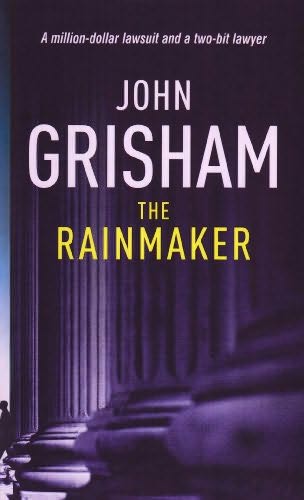
Corey Trinetti - The Rainmaker


The Rain Maker

By: John Grisham

Blog By: Corey Trinetti


Plot Summary:

The Rainmaker by John Grisham tells the story of Rudy Baylor, a recent graduate from Memphis State Law School. Rudy’s story begins with him working in a local bar serving his former classmates drinks. These people didn’t have to work at the bar like Rudy, they were ‘the privileged ones’ the ones with connections and job opportunities to the most well-known and respected firms in the country. Rudy would have to hunt for and earn his place in the lawyer-infested town of Memphis, Tennessee. But things seemed to take a turn for the better when Rudy was approached with an opportunity, an opportunity that would soon have Rudy’s life turned upside down. Rudy was brought to the office of a man named J. Lyman Stone or "Bruiser". He was offered an interesting proposition, no salary, but 1/3 commission on any monies brought into the firm. Desperate as he was, Rudy accepted the position and began work immediately. At the firm, Rudy met a man by the name of Dick Shifflet, a highly unethical and unlicensed lawyer, having failed the bar exam six times. Rudy is introduced by Dick into the world of “ambulance chasing”, a form of soliciting their law services to people immediately after they have been injured. With Rudy’s employer about to be raided by the FBI, Rudy and Dick decide to set up their own firm. Their first case, and the most important one in the novel, is an insurance claim representing the family of Dot and Buddy Black, and their son, Donny Ray. Rudy is very passionate about doing what is right in this case and bringing justice to Great Benefit, an insurance company that has ignored the suffering of Donny Ray who is dying of leukemia. Rudy knows that Great Benefit will put up an enormous fight, with their endless supply of experienced lawyers, in order to keep from losing millions of dollars in damages. Before trial commences, the Black’s son Donny Ray dies, devastating his entire family, including Rudy. The case goes to trial and Rudy is faced with a variety of obstacles. Rudy is not able to win over the jury until he discovers a scheme that Great Benefit ran to deny every insurance claim submitted, regardless of its validity. Great Benefit is exposed and the verdict goes in favor of Rudy and the Blacks. Unfortunately, Great Benefit declares bankruptcy and no damages are ever paid. Affected by these events, Rudy vows to leave his life as a lawyer and the city of Memphis entirely.


Comments on Author's Use of Certain Elements:

Grisham’s character development in this novel is done exquisitely. Each character is crafted in a way that fits typical stereotypes, yet these characters still have an original flare to them. In particular, I was impressed with Rudy Baylor’s character development. Rudy is a smart, but financially troubled young man who is looking to strike it big in the field of law. This is a classic David vs. Goliath story. Rudy is thrust into a high profile case in which he is in way over his head and has to outsmart veteran lawyers. Eventually Rudy (the David in this story) defeats the Great Benefit lawyers (Goliath) to everyone’s amazement and joy. The dialogue in this novel is also stellar; Grisham seems to have a thorough understanding of court room terminology and the laws that go with the court system. He seems to know how the court is supposed to function; for example, Rudy is corrected by the judge several times throughout the novel about not abiding to proper court room conduct.


Quote Several Sentences That Appeal:


“The initial claim from Mrs. Black was assigned to me. Pursuant to company policy at the time, I sent her a letter of denial.” – Jackie Lemancyzk
“Why?” – Rudy Baylor
“Because all claims were initially denied.” – Jackie Lemancyzk
“All claims?” – Rudy Baylor
“All claims.” – Jackie Lemancyzk

This dialogue between Rudy Baylor and Jackie Lemancyzk appealed to me because it was the first time that the scheme behind Great Benefit was uncovered. The scheme was to deny every insurance claim submitted, regardless of its validity. This showed Great Benefit’s horribly unethical scheme, to test the will of its customers and see if they were persistent enough to make the same claim over and over again for insurance coverage.


“Every lawyer, at least once in every case, feels himself crossing a line he doesn’t really mean to cross. It just happens. And if you cross it enough times, it disappears forever. And then you’re nothing but another lawyer joke, just another shark in the dirty water.”

This quote appeals to me because it is at the end of the novel and sums up one of the major lessons of the book. The lesson is that sometimes we are forced to do bad things we aren’t supposed to do, and that is alright. But if we repeatedly abuse and do things we aren’t supposed to, we have become unethical. And, if we have become unethical, then we are no longer ourselves anymore, we have become another ruthless lawyer, businessman or whatever we may be.


“How do you know when a lawyer is lying? His lips are moving.”

This quote appeals to me because it is a little bit of humor in a rather serious book. Although this quote is funny, it pertains to the novel and is a very simple explanation about how a lawyer will try to manipulate and mess around with you. Basically, in this book, you cannot trust anyone and, in order to keep your guard up, you must always consider the fact that they might be lying.